




Exploring ASL learning barriers for hearing parents of deaf children
PARTNER
PopSignAI
PopSignAI is an educational game app that uses sign language recognition, to make learning American Sign Language fun, interactive, and accessible.
ROLE
UX Designer & Researcher
TOOLS
Figma, Qualtrics, MAXQDA
SKILLS
Participatory Design, Qual & Quan Methods, Accesible Design
DURATION
1 Year
May - May 2026
Overview
SignFables: Designing for Shared Storytime
Exploring ASL learning barriers for hearing parents of deaf children
During my time as an MS-HCI student at Georgia Tech, I worked as a co-lead researcher on a year-long project exploring how interactive technology could support hearing parents of deaf and hard-of-hearing children learning American Sign Language (ASL).
Through interviews with parents, collaboration with ASL educators, and iterative prototyping, our team developed SignFables, a tablet-based storytime companion designed to integrate ASL learning into everyday family routines.
Rather than treating language learning as an isolated activity, we explored how technology could support communication and shared learning between parents and their children.
Background
Approximately 90–95% of deaf children are born to hearing parents, many of whom have little or no prior experience with sign language. For these families, learning ASL often becomes an urgent and unfamiliar responsibility during an important period of their child's development.
Although digital ASL learning resources have become increasingly available, many focus primarily on teaching individual signs rather than helping learners develop conversational skills. Parents may accumulate vocabulary without gaining the confidence or grammatical understanding necessary to communicate effectively with their children.
Our research explored how technology could better support these families, particularly through activities already embedded in their daily lives.
Problem Statement
How might we support hearing parents of deaf children in developing practical ASL skills through meaningful, everyday interactions with their children?
User Research
To better understand the experiences of hearing parents learning ASL, we conducted seven semi-structured interviews with eight parents of deaf or hard-of-hearing children, ranging in age from seven months to nine years.
We explored their experiences learning ASL, the resources available to them, their family communication practices, and the challenges they encountered during shared reading and bedtime routines.
Following these interviews, we used affinity mapping to identify recurring themes and inform our design priorities.
Key Research Findings
1. Learning ASL is a family experience.
Parents frequently described learning ASL alongside their children and other family members. Shared learning opportunities were important not only for developing communication skills, but also for strengthening family relationships.
2. Knowing individual signs does not necessarily translate into conversation.
Many parents expressed frustration with resources that prioritized isolated vocabulary over ASL grammar and sentence structure. Despite learning new signs, they often struggled to apply that knowledge in everyday communication.
3. Storytime presents unique physical and attentional challenges.
Reading with a deaf or hard-of-hearing child can require parents to manage a physical book, produce signs, and coordinate their child's visual attention simultaneously. Parents with limited signing experience often interrupted reading to look up unfamiliar signs.
4. Access to learning resources varies significantly between families.
Geography, financial resources, and access to Deaf mentors or educational programs shaped parents' learning experiences. Some families had extensive support, while others relied almost entirely on independently accessible online resources.
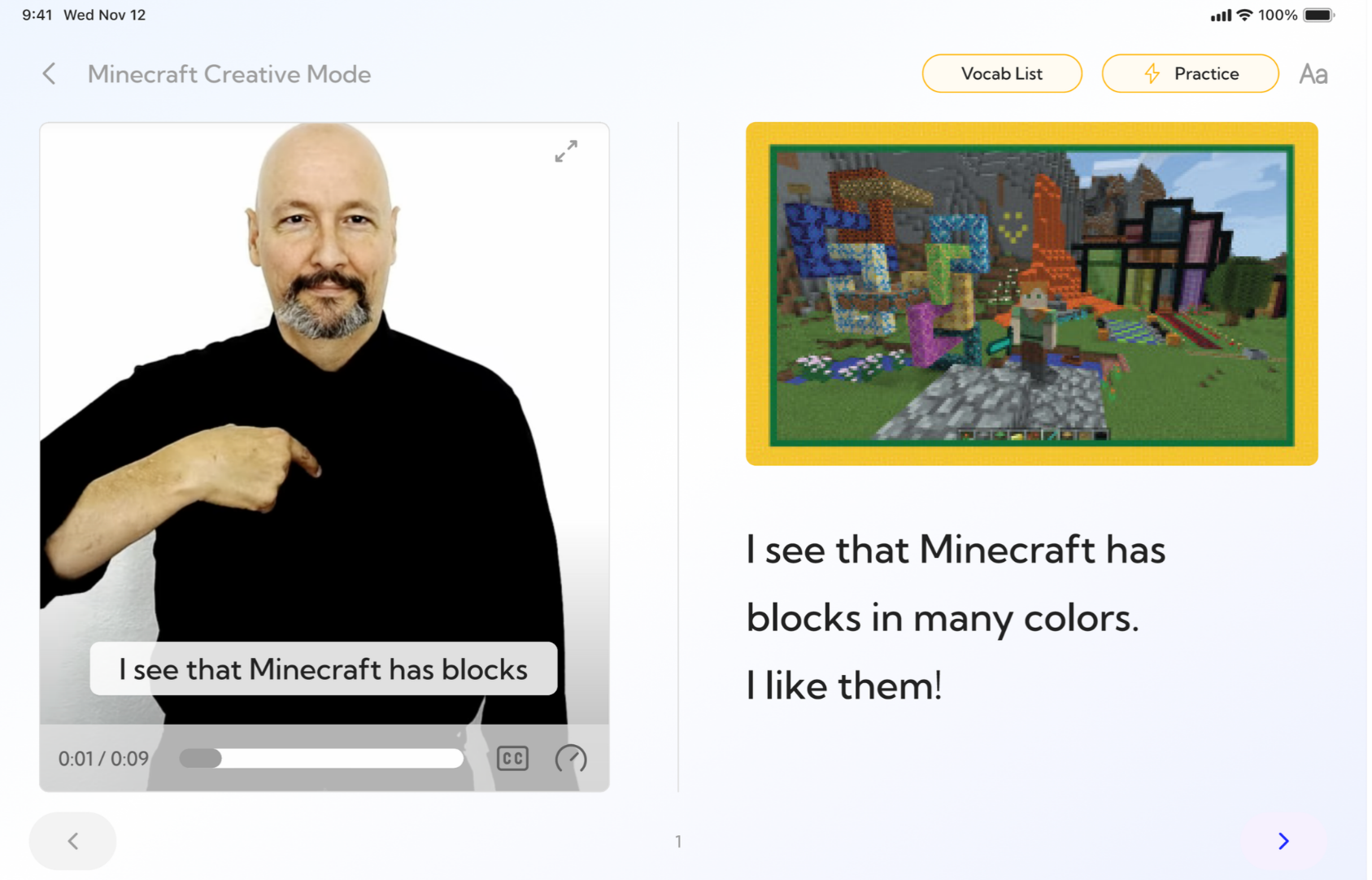
SignFables: An interactive storytime companion designed to bring ASL learning into family reading routines.
Informed by our formative research, we developed SignFables, a tablet-based application that combines traditional storybooks with ASL video interpretations, contextual vocabulary practice, and customizable learning tools.
The application was designed to support both collaborative reading between parents and children and independent preparation before storytime.
Its primary features include side-by-side English text and ASL video, story-specific vocabulary lists, flashcards, quizzes, adjustable video playback, and customizable reading preferences.
Concept Exploration
We began with a Crazy 8s ideation session, exploring four possible approaches: side-by-side reading, ASL video overlays, an augmented reality book companion, and a generative storytelling concept.
We presented these early designs to a focus group of three parents who had participated in our initial interviews.
The side-by-side reading concept received the strongest response. Parents appreciated being able to follow a story while simultaneously viewing its ASL interpretation, without needing to navigate away from the reading experience.
Incorporating Educator Feedback
To strengthen our approach, we also interviewed four ASL educators, including one Deaf educator.
Their feedback reinforced the importance of introducing ASL grammar rather than relying on English sentence structures, prioritizing visual instruction, and accommodating different learning preferences.
These conversations helped us refine SignFables into a more flexible learning environment, allowing parents to adjust the amount of English support and progress at their own pace.
We evaluated our high-fidelity prototype through task-based usability testing with six parents of deaf or hard-of-hearing children.
Participants completed tasks involving navigation, reading preferences, vocabulary practice, and other learning features. Following the sessions, we collected feedback through debriefing interviews and the System Usability Scale (SUS).
SignFables achieved a SUS score of 93, indicating excellent perceived usability.
Testing also revealed important differences in how parents wanted to engage with the application. Some preferred additional English-language support, while others wanted a more immersive ASL experience.
Based on these findings, we refined the onboarding experience, clarified navigation elements, and introduced more visible reading-progress indicators.
This project reinforced the importance of designing technology around the routines, relationships, and constraints that shape people's everyday experiences.
Our research demonstrated that parents were not simply looking for another vocabulary-learning application. They wanted resources that could help them communicate more confidently with their children without introducing additional demands into already complicated routines.
Although SignFables remains a prototype, our findings suggest opportunities for more flexible, contextual, and collaborative approaches to accessible educational technology.
Future development would benefit from deeper co-design with Deaf educators and families, functional implementation, and longitudinal evaluation within real parent-child storytime environments.
For me, this project highlighted the value of involving families throughout the research and design process, particularly when developing technology intended to support children's everyday experiences.